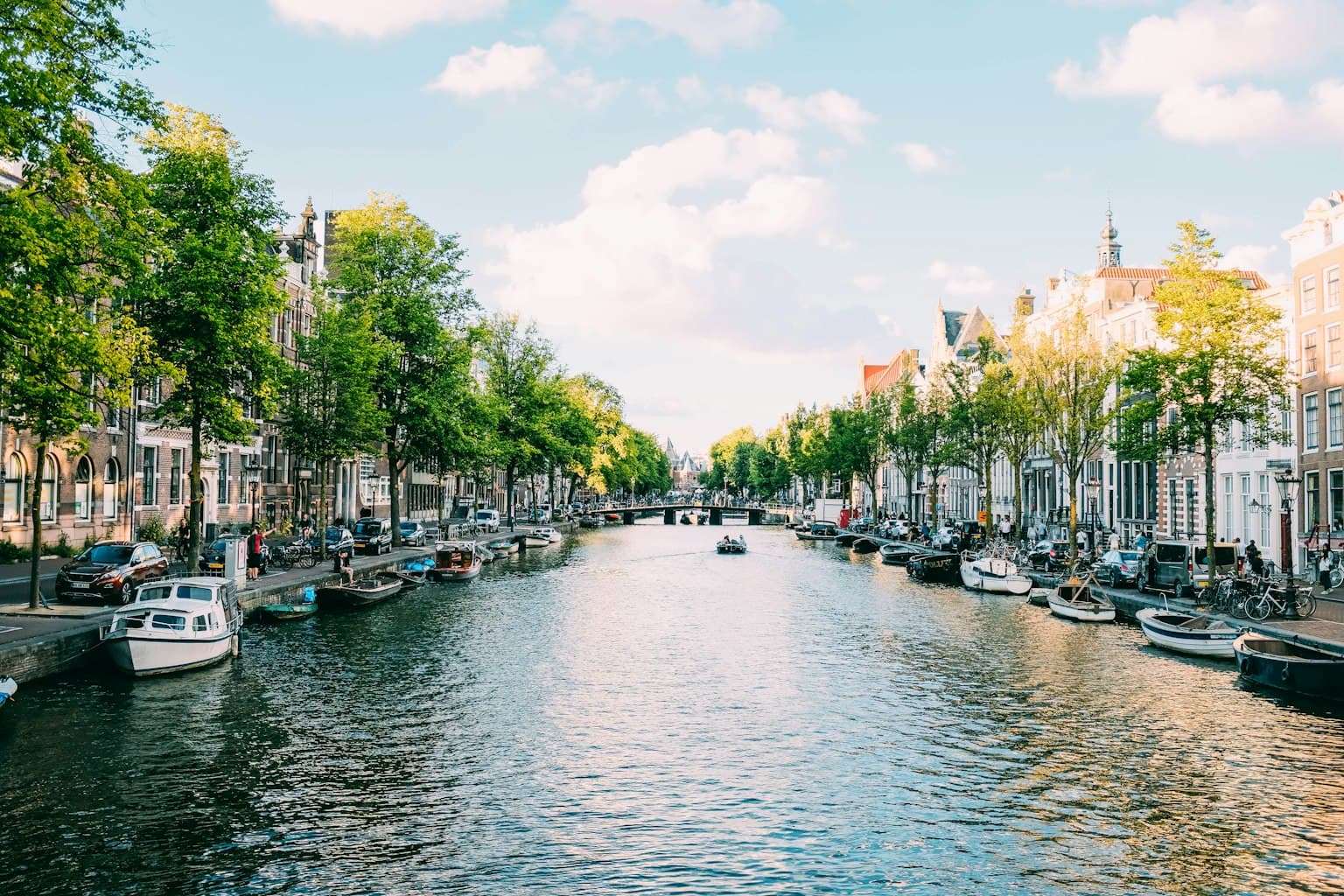
Amsterdam gets underestimated by its own clichés. The canal houses, the bikes, the red-light district, the Van Gogh Museum, a brown café, maybe a "coffee shop" — it's the standard itinerary, and it barely scratches the surface. Because Amsterdam is actually one of the most layered small cities in the world: a global design capital, a culinary dark horse, a cycling utopia with village-scale neighborhoods, and a city whose relationship with water, tolerance, and commerce has shaped four centuries of history in ways most visitors never learn about.
Amsterdam rewards travelers who know what they're looking for — and disappoints the ones who don't.
The problem with most Amsterdam trips is that they treat the city as a two-day checklist: museums, canals, done. But Amsterdam is a city that reveals itself through neighborhoods, not landmarks. The Jordaan, with its galleries and boutiques and quiet courtyards called hofjes, is a completely different experience from De Pijp, with its market culture and immigrant-community energy. Amsterdam Noord, across the IJ, is a post-industrial creative frontier. And the Plantage, Amsterdam's old Jewish quarter, is one of the most emotionally resonant neighborhoods in Europe.
At Wayfound, we've identified 12 travel archetypes — patterns of curiosity, motivation, and instinct that shape what a great trip looks like. Amsterdam is a city that responds dramatically to this idea, because its depth is in the details, not the landmarks. Two travelers can walk the same canal and have entirely different trips depending on whether they ducked into the hofje, the gallery, the Indonesian restaurant, or the design shop.
Below are five three-day itineraries, each designed around a specific travel archetype. Every recommendation is real, specific, and current. The real point is seeing how different the right Amsterdam looks when you stop planning for the postcard and start planning for yourself.
The Amsterdam the tourists cycle past
The Cultural Immersive wants to understand how a place actually works — the daily rhythms, the neighborhood textures, the version of the city that belongs to the people who live there. In Amsterdam, one of the most bike-friendly, human-scaled cities in Europe, this archetype thrives. The real Amsterdam isn't in the museum queue — it's in the hofjes, the neighborhood markets, the Indonesian warungs, and the brown cafés where the same people have been sitting for decades.
Morning exploring the Jordaan on foot — skip the shops at first and find the hidden hofjes (courtyard gardens): the Karthuizerhof and the Begijnhof are both open to quiet visitors. Coffee at Winkel 43 (try the apple pie — it's a citywide institution). Lunch at a Surinamese roti shop in the Kinkerbuurt. Afternoon at the Amsterdam Museum (newly renovated, excellent on the social history of the city). Evening at a brown café — Café 't Smalle in the Jordaan or Café Papeneiland.
Morning at the Albert Cuypmarkt in De Pijp — the most multicultural market in the city. Walk the surrounding streets: this is where Amsterdam's Indonesian, Turkish, Moroccan, and Surinamese communities have built something genuinely hybrid. Lunch at a warung for rijsttafel. Afternoon walking the Plantage neighborhood — quiet, green, haunting (this was the center of Amsterdam's Jewish community before the war). Evening: dinner at a neighborhood restaurant in the Jordaan, not one with English menus.
Ferry to Amsterdam Noord — the former shipyard district across the IJ. Explore the NDSM Wharf: a post-industrial cultural village with studios, a flea market (weekends), and art everywhere. Lunch at Café de Ceuvel (a sustainable café on a decontaminated shipyard). Afternoon at the EYE Filmmuseum (the building alone is worth the trip). Evening: return for dinner in De Pijp.
Amsterdam as a design city
The Creative Spirit is drawn to places with strong aesthetic intelligence — where design, architecture, and visual culture are part of the daily environment, not reserved for museums. Amsterdam, which has been a global center of graphic design, architecture, and applied art since the De Stijl movement, is quietly one of the most design-literate cities in the world. The creative infrastructure — the galleries, the studios, the concept stores — is woven into the residential fabric.
Morning at the Rijksmuseum — not just for the Rembrandt (though the Night Watch is unmissable), but for the building itself, the Asian Pavilion, and the library. Lunch at the museum café or Café de Jaren nearby. Afternoon at the Stedelijk Museum — one of Europe's best modern and contemporary collections. Walk through the Museumplein. Evening: independent galleries in the Jordaan (Torch Gallery, Upstream) or catch whatever's on at Paradiso (the converted church venue).
Morning at the Foam photography museum on Keizersgracht. Walk the canal ring photographing the architectural details — gable stones, shutters, the lean of the buildings. Lunch in De Negen Straatjes (Nine Streets) — tiny shops, each with a distinct point of view. Afternoon at the Huis Marseille photography museum or the Architecture Centre (ARCAM) near Central Station. Evening exploring Amsterdam Noord: street art, converted warehouses, the Tolhuistuin cultural center.
Morning at the Het Schip housing complex in the west — Amsterdam School architecture at its most ambitious (a social-housing block designed as a work of art in the 1920s). Walk through the Westerpark area. Afternoon browsing the design shops: Droog in the center, Hutspot in De Pijp, and the concept stores on Haarlemmerdijk. Evening: catch a performance or film at the EYE or a concert at Muziekgebouw aan 't IJ.
Amsterdam's quiet food revolution
The Bon Vivant builds a trip around pleasure — and Amsterdam, long dismissed as a city where you eat to survive rather than to enjoy, has undergone one of Europe's most surprising culinary transformations. The Indonesian food has always been extraordinary. Now the new-wave Dutch cooking, the natural wine scene, and the market culture have caught up. For the Bon Vivant, Amsterdam in 2025 is a genuine food city — just one that doesn't brag about it.
Morning at the Noordermarkt (Saturday organic market in the Jordaan). Start with apple pie at Winkel 43, then graze: artisan cheese, fresh stroopwafels, herring from the fish cart. Lunch at Bar Centraal — elevated Indonesian cuisine. Afternoon: cheese tour at Reypenaer (tasting, not shopping). Evening: cocktails at Tales & Spirits, dinner at Bak — Amsterdam's most beautifully sparse restaurant, all windows and water.
Morning Indonesian food tour of De Pijp — start with a rijsttafel lesson. Visit the Albert Cuypmarkt for the raw herring (eat it Dutch style, with onion and pickle). Lunch at The Seafood Bar. Afternoon: wine tasting at Glou Glou (Amsterdam's natural-wine epicenter). Evening: dinner at Choux — French-Dutch, intimate, excellent. Nightcap at a brown café with a jenever (Dutch gin).
Morning at the Foodhallen in Oud-West — converted tram depot, best for a late-morning graze across cuisines. Walk through the Vondelpark. Lunch at Rijsel — former Michelin-star chef, now doing Flemish comfort food at communal tables (the duck is legendary, book ahead). Afternoon: visit a craft distillery (House of Bols or Wynand Fockink, which has been pouring jenever since 1679). Evening: splurge dinner at Ciel Bleu or spectrum.
Amsterdam as a lesson in civilization
The Lifelong Learner travels to understand — to see how a place works, why it was built this way, what forces shaped the culture and the landscape. Amsterdam is one of the great Lifelong Learner cities because its history is both extraordinary and legible: the canal ring was planned. The tolerance was deliberate. The relationship with water is an engineering marvel. And the 20th-century history — Anne Frank, the occupation, the rebuilding — is among the most important and best-preserved anywhere.
Morning at the Anne Frank House (book timed entry well ahead). Walk the canal ring — it's a UNESCO World Heritage site designed in the 17th century as both infrastructure and social order. Lunch in the Jordaan. Afternoon at the Amsterdam Museum for the social and political history. Evening: attend a lecture or event at Felix Meritis or De Balie — Amsterdam's intellectual-cultural centers.
Morning at the Rijksmuseum — focus on the 17th-century Golden Age galleries and the way they tell the story of trade, empire, and wealth. Lunch at Café de Jaren (read the English-language Dutch papers). Afternoon at the Tropenmuseum — one of the best ethnographic museums in Europe, unflinching about colonial history. Evening: documentary screening at the EYE Filmmuseum.
Morning water-management tour — visit the Waterlooplein area and learn how Amsterdam literally created itself by draining and filling land. If time, day trip to the Afsluitdijk or the Beemster Polder (UNESCO). Alternatively: the Resistance Museum for WWII history, then the Portuguese Synagogue. Lunch in the Plantage. Afternoon at NEMO Science Museum (hands-on, surprisingly sophisticated). Evening: bookshop browsing at the American Book Center, dinner in the Jordaan.
Amsterdam at the next frontier
The Urban Trendster is drawn to where a city is actively reinventing itself — the neighborhood that just shifted, the cultural space that opened last season. Amsterdam, despite being small, reinvents its edges constantly. Noord went from industrial wasteland to creative frontier in a decade. Oud-West became the city's coolest residential neighborhood almost overnight. And the ongoing development of the IJ waterfront is producing some of the most interesting architecture in Europe.
Morning coffee at Lot Sixty One in Oud-West, then browse the boutiques on Kinkerstraat and Jan Pieter Heijestraat — the new center of Amsterdam cool. Lunch at the Foodhallen. Afternoon: ferry to Amsterdam Noord. Explore the A'DAM Tower (the swing on the roof is genuinely terrifying), the STRAAT street art museum, and the cafés around NDSM Wharf. Evening: drinks at Shelter (a club in a former WWII bomb shelter under the A'DAM Tower), dinner at Hotel & Restaurant De Goudfazant in a converted garage.
Start at the Stedelijk Museum for the contemporary collection. Walk through the Nine Streets for indie retail. Lunch at Café Modern on the Westerpark. Afternoon exploring the De Hallen complex (former tram depot, now a cultural center with a cinema, library, and food market). Evening: natural wine at Glou Glou, then whatever DJ or live act is playing at Paradiso or Melkweg.
Morning at the Architecture Centre (ARCAM) to understand what's being built and why. Walk the Eastern Docklands — the most architecturally adventurous residential neighborhood in Europe (Borneo-Sporenburg, the Python Bridge). Lunch at Hangar on the NDSM Wharf. Afternoon browsing concept stores: The Maker Store, Hutspot, and the shops along Czaar Peterstraat. Evening: explore the emerging bar scene in Oost — Flevopark-area wine bars and the cafés along Javastraat.
Closing note
Five completely different three-day trips in one of Europe's smallest major cities. The Cultural Immersive found a version of Amsterdam that most tourists cycle right past. The Bon Vivant discovered a food city that doesn't advertise itself. The Urban Trendster's Amsterdam and the Lifelong Learner's Amsterdam share almost none of the same stops. That's the point: even a city this compact has enough depth to mean something completely different depending on who's doing the exploring. If you're not sure which version is yours, the quiz can help.
Which traveler type are you?
Take the Wayfound quiz to discover your archetype, then come back and read the Amsterdam itinerary that fits you best.